Hudson Valley Regional Council’s Annual Conference and Awards Celebration – November 6, 2026
Deputy Executive Director, Amanda Peçanha Hickey
Theme: Waste Management Challenges & Solutions in the Region
It was an exciting day of embracing challenges and empowering solutions! Here is what you missed:
-
- There is a long road ahead for the Mid-Hudson Region as it pursues the ambitious Waste Reduction target set by New York State: 85% of waste diverted from landfills and incinerators by 2050.
- The Mid-Hudson Region Currently produces 3.83 million tons of total waste (New York State Solid Waste Management Plan, 2025). 38% of it is recycled. As the Region has no active landfills, all waste is expensively exported outside of the Region or incinerated.
- Additionally, the Region’s closed landfills are producing leachate which poses a threat to the health of communities and the environment. Research has identified 301 possible chemicals to emerge from landfill leachate, 187 of them have been found in New York landfills, including PFAS, which were present in all nine regional landfills tested.
*Please see conference slides and reading packet for data sources and references from our speakers.
It’s not all doom and gloom!
Presenters from the DEC, HVRC, the regional Materials Management Working Group, and resource partners elevated great work- already underway- to scale up existing solutions and create new ones-
- Across the region and the state, leaders are embracing the importance of the Circular Economy- moving away from “take, make, toss” to an economic model that keeps materials in play:
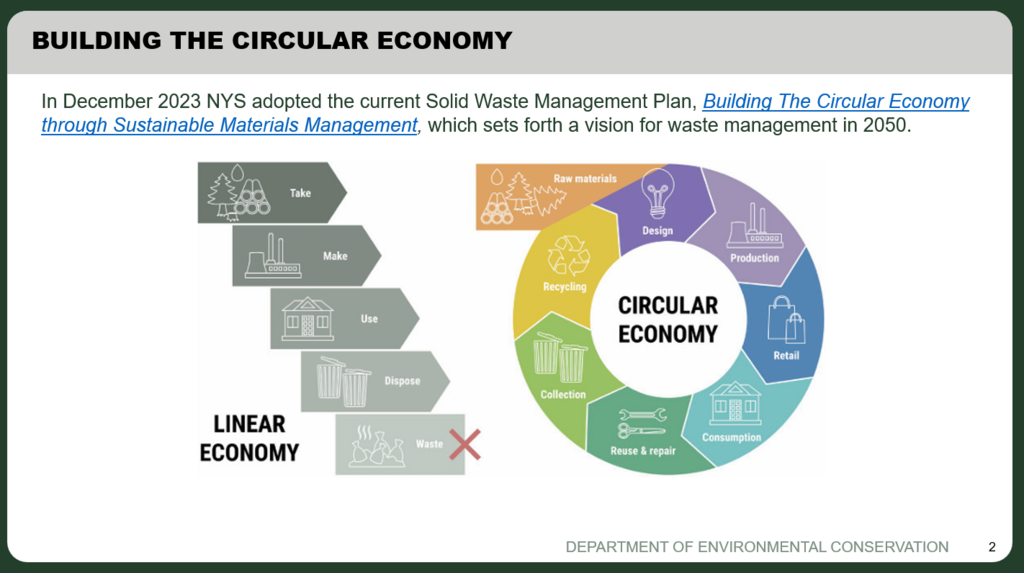
Courtesy of D. Upright, DEC
- New legislation has been enacted to mandate more food scrap diversion from institutions and businesses and extending producer responsibility for products like carpets and rechargeable batteries. The Department of Environmental Conservation (DEC) is partnering with industry and researchers to evaluate the effectiveness of the State’s current recycling system and recommend improvements.
- The science of isolating and destroying harmful chemical compounds found in landfill leachate is advancing every day.
Our local communities are answering the call!
Members of the regional Materials Management Working Group highlighted innovative initiatives that are already generating positive momentum:
| Ulster | Securing investment for a ReUse Innovation Center, launched a corps of Master Composter and Recycler Volunteers at work in the Community |
| Dutchess | Reduced contamination with compliance inspections |
| Orange | Launched “Recycle Coach” mobile tool, food scrap recycling at Farmers Markets |
| Sullivan | Waste to Energy procurement initiative |
| Rockland | Opened the Rockland Green Experience and Education Center |
| Putnam | Tackled “hard to recycle” materials and found solutions for vapes and mattresses |
| Westchester | Expanded partnerships to tackle textile recycling and food scrap collection |
Just to name a few. Members of the Materials Management Working Group emphasized the importance of regional collaboration- “Together, the seven counties of Region 3 are developing solutions that none could achieve alone,” emphasized Chair Ermin Siljkovic. Resource partners Recycling Resource Solutions (RRS) demonstrated what that could look like in practice with examples of intermunicipal collaborations on waste management solutions from across the nation.
Speakers also shared solutions for diverting more Construction and Demolition waste, and tackling specific, significant waste streams like furniture, appliances, and textiles. Next, a video presentation raised the question: if we must incinerate, can we do it better and cleaner? The jury is still out. Finally, the day ended with a workshop which invited participants to reflect on Throwaway Culture- how it shows up in our daily lives, and what each of us can do within our spheres of influence to tackle it.
A highlight of the day was the annual HVRC awards ceremony, celebrating the achievements of three committed partners who made positive impact in their communities over the past year.
First, the “Potential Energy” Award (as in the stored energy that can be converted to other kinds) was awarded to Rockland County in recognition of the fantastic planning and strategy documents they completed and have in progress- setting the course for a sustainable and resilient future for those communities.
The Kinetic Energy award recognized Putnam County’s Ilona Campo- who’s commitment to delivering a high quality and comprehensive Adaptation and Resilience Plan was truly humbling- and yielded results!
Finally, the Radiant Energy award recognized the collaborative problem solvers participating in the Materials Management Working Group for their leadership on this crucial issue. HVRC is honored to support this group.
The day wrapped with a call to action from Working Group Chair Siljkovic and HVRC Executive Director Carla Castillo: “To continue expanding our Region’s ability to address our waste management challenges, the Region would benefit from a Regional Feasibility Study…such a study would identify solutions married to their most successful scale.”