
Methane. From Flaming Seeps to Measurements in Flight: Katie’s journey to HVRC
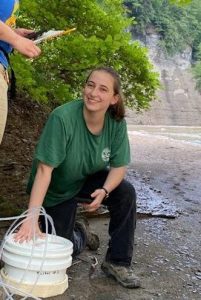
Figure 1. Katie conducting methane flux chamber measurements in western New York.
The Hudson Valley Regional Council has a new Environmental Scientist!
In August, Katie Hall joined HVRC as an environmental scientist. She grew up in Rhinebeck, NY, within Dutchess County, where she developed a love for science, community work, and the environment. She moved to Rochester, NY to pursue bachelor’s and master’s degrees in environmental science. There, she had the opportunity to join the Ice Core and Atmospheric Chemistry Lab, where she researched methane emissions.
Methane: What is it, Where Does it come From, and Why do We Care?
Methane is an important gas that can be combusted for energy. It is the primary ingredient in the natural gas we use for our stoves and heaters. Natural gas burning power plants were the largest source of electricity for the U.S. in 2025 (U.S. Energy Information Administration (EIA)). For this reason, methane can also pose an explosive hazard when it accumulates in confined spaces, such as in buildings. Studies have also found that methane emissions alone have contributed to a ~0.6 °C rise in global surface temperatures since 1750 (Intergovernmental Panel On Climate Change (IPCC), 2023).
In the lower part of the atmosphere, methane reacts with other gases to form ozone. While ozone in the upper atmosphere protects us from harmful UV radiation, ozone in the lower atmosphere harms human health and agriculture. Long-term exposure to ozone can lead to respiratory mortality and the risk of cardiovascular disease. Ground-level ozone is responsible for about 1MM premature deaths globally (Malley et al., 2017), with half of the observed increase in ground-level ozone attributed to increased methane emissions. Methane emissions are also often mixed with other gases that pose dangers to human health, such as volatile organic compounds (VOCs), hydrogen sulfide, and more.

Figure 2. Sources and sinks of methane to the atmosphere. Anthropogenic, or human-caused emissions are on the left (Fossil fuel production and use, agriculture and waste, and some biomass burning. Natural sources are dominated by wetlands with natural sinks from chemical reactions in the atmosphere and microbes in the soil.
The amount of methane in the atmosphere depends on the magnitude of the sources and sinks of the gas into and out of the atmosphere. Methane is naturally emitted into the atmosphere largely from wetlands and freshwater areas, but also from termites, wild animals, oceans, permafrost, and geologic sources. Methane is removed from the atmosphere by reacting with other gases and eventually being turned into carbon dioxide. It is also eaten by specially-adapted microbes in the soil.
These natural dynamics are, for the most part, in balance. The amount of methane in the atmosphere can be thought of as a bathtub full of water. Just as water flows into a bathtub through a faucet, methane is emitted into the atmosphere. However, a bathtub also has a drain. The drain removes water from the bathtub, like the gases in the atmosphere and microbes remove methane. If the flow in from the faucet and out from the drain are similar, the water level in the tub stays the same.
However, if the faucet is turned up too high, water will accumulate and overflow as the drain fails to keep up. Similarly, our methane emissions from the fossil fuel industry, agriculture and waste, and biomass burning have “turned the faucet up” and caused methane to accumulate in the atmosphere.
Therefore, methane is an important thing to study! Katie’s previous work focused on measuring and understanding the different sources and sinks of methane to the atmosphere. How do scientists measure emissions of this important gas?
Katie’s Previous Work
Geologic Methane Emissions
One unconventional source of methane to the atmosphere is from geologic sources. These are places where the natural gas held in reservoirs in the earth migrates to the surface through cracks, fractures, and exposures of shale and coal rock. There it seeps out – bubbling in low-lying creeks and leaking out of rocks. It gurgles out of mud volcanoes and, in other places, can be lit on fire as “eternal flames” like the one in Chestnut Ridge Park near Buffalo, NY (Figure 3).
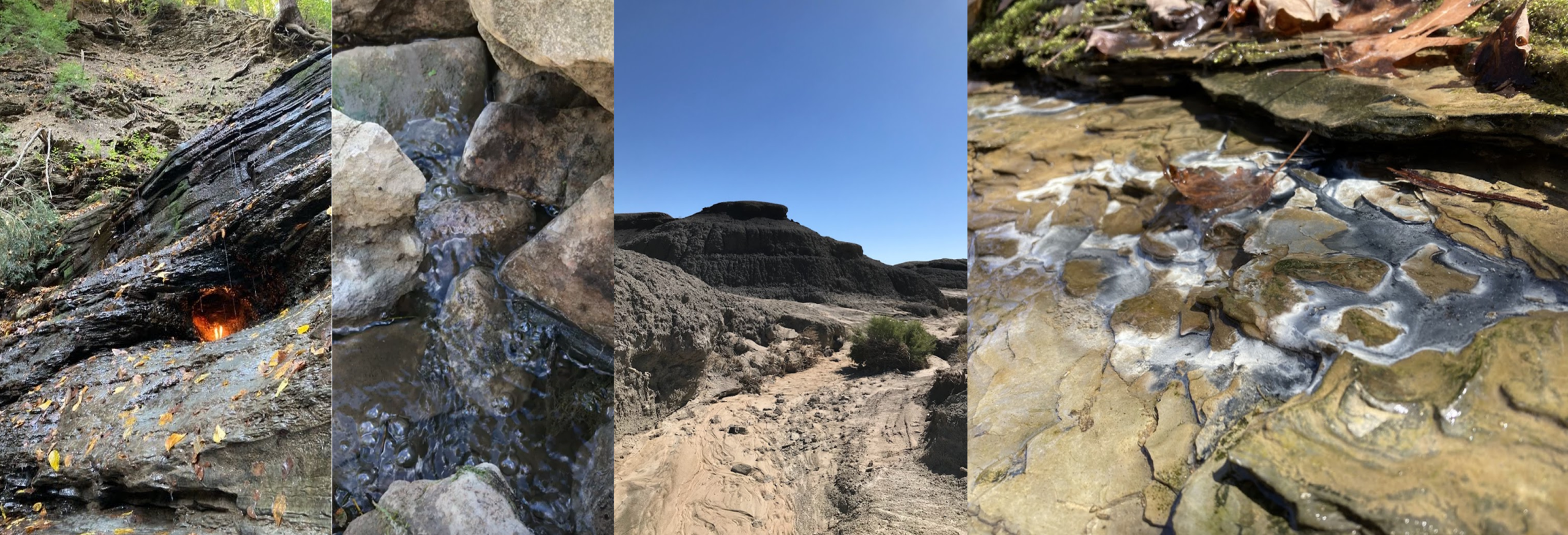
Figure 3. Sites of geologic seepage of methane. The famous seep called the “Eternal Flame” at Chestnut Ridge Park is shown on the left. Other images show outcrops of shale and coal with methane seepage in western New York and Colorado.
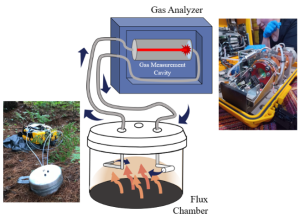
Figure 4. Schematic of a flux chamber measurement showing a flux chamber with gas accumulating from emissions. Air is shown circulating between this chamber and a gas analyzer which measures the amount of methane in the air using an infrared laser.
How much methane this source leaks into the atmosphere is highly uncertain, with small isolated pockets of seepage scattered around the earth and estimates from different methods that conflict with each other (Etiope et al., 2019; Hmiel et al., 2020). This uncertainty motivated the project that Katie’s thesis advisor, Dr. Vasilii Petrenko, created, and she spent five years working on.
Method: Flux Chamber Measurements
She and her fellow students focused on measuring small, low-level emissions of the source over large areas. For such low-level emissions, they used flux chambers. These chambers are containers that sit on the ground, with the bottom open to the ground where methane enters the atmosphere. As methane builds up in the chamber, a gas analyzer is attached and exchanges air with the chamber, measuring how fast the methane builds up. From these measurements, they can precisely calculate how much methane is entering the atmosphere.
Katie led her fellow students in multiple campaigns to measure these low-level emissions over vast regions in the U.S., including across Michigan, Colorado, New Mexico, New York, and Appalachia. By measuring these emissions across such large areas, they determined that they were less extensive and had been overestimated in previous studies (Hall et al., 2026).
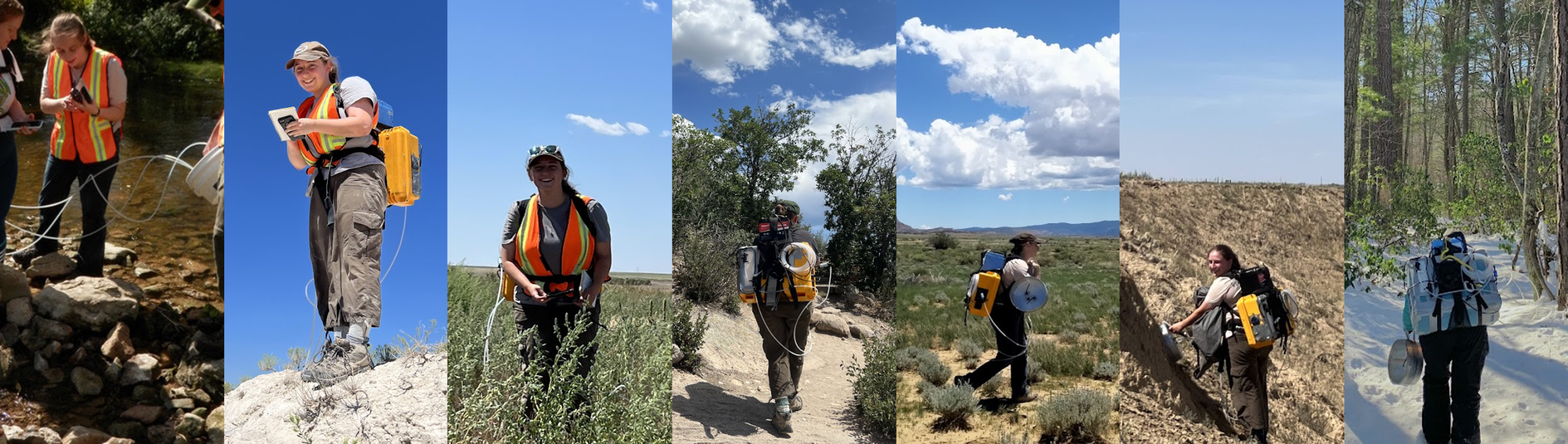
Figure 5. Pictures of Katie in the field collecting flux chamber measurements of methane emissions across New York, Colorado, New Mexico, Michigan, and Appalachia.
Point Sources with Aircraft at NASA
There are many ways to detect methane emissions from large, focused sources such as leaking fossil fuel infrastructure. One way is to fly airplanes at low altitudes to measure the air near these point sources.
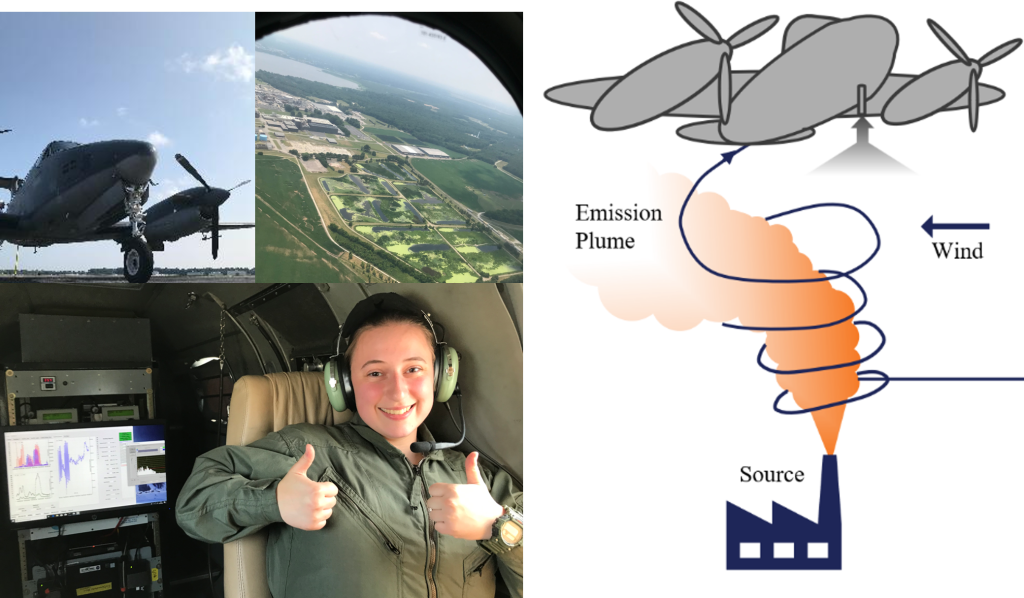
Figure 6 (left). Images outside of and from the airplane collecting gas measurements. Katie is shown next to an instrument measuring aerosols and particulate matter. Figure 7 (right). Diagram of the flight path of an airplane measuring a plume of emissions from a point source of pollution.
Method: Airborne Measurements
The Student Airborne Research Program at NASA performs these types of measurements. They fly to these point sources of pollution with instrumentation on board (Figure 6), which measures methane and several other pollutants such as particulate matter, nitrogen and sulfur compounds, formaldehyde, and ozone.
The plane flies at a low altitude towards the emission source. Once there, the plane banks at a steep angle, ascending or descending quickly while spiraling around the plume of air filled with methane and other pollutants (Figure 7). As the plane spirals, it takes in air near the nose. The instrumentation aboard this plane measures the amount of pollutants in the air. These data are then used to model the motion and dissolution of the emission plume and how much of each pollutant is being emitted into the atmosphere.
Measurements like these help NASA validate its satellite measurements of these pollutants, such as for the TEMPO mission, which measures air quality over the U.S.
Atmosphere’s Detergent – OH
When methane reaches the atmosphere, it is eventually destroyed by different chemical species. The primary species that does this is called the hydroxyl radical, or “OH”. When water (H2O) in the atmosphere is hit with sunlight, it splits into charged H and OH radicals. The radicals are called radicals because they readily attach to and react with other gases in the atmosphere. As such, OH grabs onto many things and effectively destroys them, including many pollutants. For this reason, it is called the “detergent” of the atmosphere.
These hydroxyl radicals also help to destroy methane and turn it into carbon dioxide. OH is responsible for ~90% of the sink, or removal, of methane in the atmosphere (Saunois et al., 2025). For this reason, scientists are very interested in OH.
Unfortunately, it is very difficult to study. These radicals form and then quickly disappear in a matter of seconds because they react so quickly. Think about trying to measure something that only exists for a blink of an eye!
Method: Global Air Monitoring and Laboratory Processing
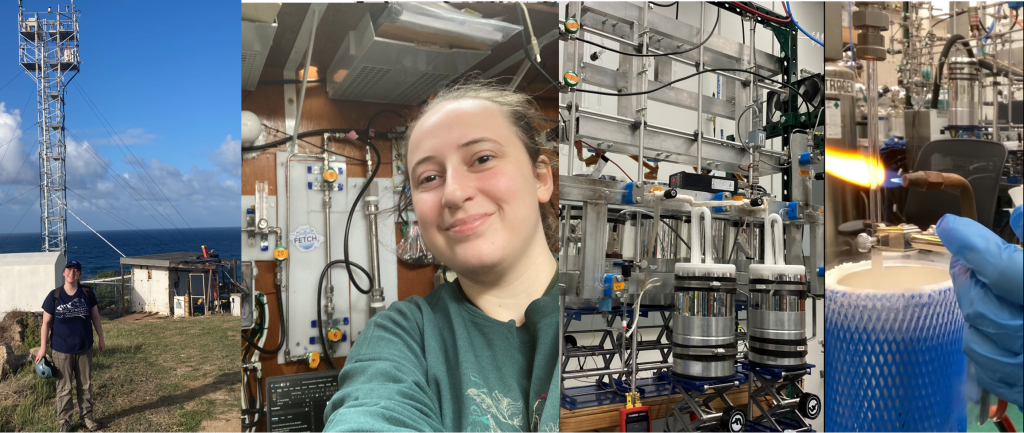
Figure 8. Katie in Barbados assisting in the installation of an autonomous air sampling system at an international observatory (left). Processing of air samples to extract carbon monoxide in the laboratory at the University of Rochester (right).
One way to measure the amount of OH is to measure a gas for which we know almost exactly how much is in the atmosphere which is destroyed by OH. One such gas is 14CO. When the atmosphere is bombarded with radiation from space, carbon-14 is formed and this forms into carbon monoxide in a very constant manner. Since we know the source of this so well, measuring the amount of 14CO in the atmosphere tells us how much is being broken down by OH and thus how much OH is in the atmosphere!
The Ice Core and Atmospheric Chemistry Lab is part of a global monitoring network called FETCH4 which measures 14CO collected from atmospheric observatories across the world (Petrenko et al., 2021). For the air samples collected, Katie and other scientists worked to extract the CO out of the air using very cold temperatures and combustion then the carbon is measured for carbon-14.
With these measurements, scientists can use state-of-the-art global climate and chemistry models to determine the amount of OH in the atmosphere and how much methane it consumes.
Soil Sink from Flux Chamber Measurements
Soils are also a place where methane comes out of the atmosphere. Microbes live in dry, upland soils that eat methane right out of the atmosphere. These special microbes are called methanotrophs.
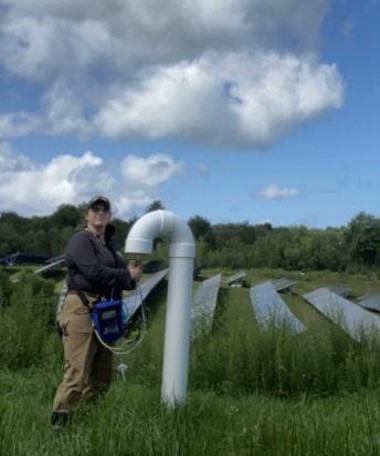
Figure 9. Katie in the field measuring methane emissions from a landfill vent in the Mid-Hudson Region for HVRC.
The effect of these microbes can be measured with flux chambers. Instead of methane building up in this chamber, these microbes eat and remove methane. The amount of methane the microbes collectively remove from the atmosphere varies in different ecosystems and climates. For example, they consume less methane in environments with a lot of water in the soil (Song et al., 2024). They are also sensitive to the type of soil they live in. Darker soils with more organic material, for example, remove more methane from the atmosphere (Lee et al., 2023).
Katie has utilized the flux chamber measurements she collected in her earlier work on natural geologic methane emissions to study these microbes and how much methane they remove from the atmosphere.
From Quantification to Reducing Emissions in Her Hometown
Katie is now excited to move from measuring and understanding methane in the atmosphere to actively reducing it by working with the Hudson Valley Regional Council. She is working on their ongoing project to reduce landfill methane emissions using biofilters funded by the Environmental Protection Agency (EPA).(opens in new tab)
She will be responsible for measuring the methane emissions from these landfills and helping HVRC construct biofilters. These biofilters utilize methanotrophs, the magical, methane-eating microbes, to eat the methane from the gas leaking out of the landfills through vents (Figure 9). Even more, these biofilters are one of the most low-cost solutions to mitigate these emissions!
Katie feels honored to return to the Mid-Hudson Region and use her experience to help local governments and municipalities reduce their largest source of emissions in the very region she grew up and developed her love for the environment.
Acknowledgements
The work discussed here was funded by U.S. National Science Foundation Award AGS-2039234 (to Dr. Vasilii Petrenko), Schmidt Sciences (to Dr. Vasilii Petrenko), NASA Student Airborne Research Program (SARP), Environmental Protection Agency (to HVRC), and the University of Rochester. Vasilii Petrenko, Thomas S. Weber, Alexander C. Ihle, Margaret Scholer, Marika P. Stock, Marc L. Buursink, Haoran Piao, Mingzhe Zhu, Katey M. Walter Anthony, Robert Swap, Katherine Travis, Dennis Felikson, NASA Langley Research Center, Aparajeo Chattopadhyay, Sebastian Miller, Elizabeth Thomson, and the FETCH4 team made integral contributions to the work presented here. Photo credits to Haoran Piao, Margaret Scholer, Alexander Ihle, Sebastian Miller, Elizabeth Thomson, Jackson Begolka, and Vasilii Petrenko. Special thanks to Dr. Vasilii Petrenko for developing the projects for the majority of this work and for his and Dr. Thomas Weber’s mentorship in these projects.
Further Reading
Katie’s scientific paper on natural geologic methane emissions from Michigan: https://doi.org/10.1525/elementa.2025.00058
Margaret Scholar’s paper on natural geologic methane emissions from Colorado and New Mexico: https://doi.org/10.1525/elementa.2025.00061
Fate Emissions and Transport of CH4 (FETCH4): https://fetch4.github.io/
The Ice Core and Atmospheric Chemistry Lab at the University of Rochester: https://www.sas.rochester.edu/ees/petrenko/index.html
References
Etiope, G., Ciotoli, G., Schwietzke, S., & Schoell, M. (2019). Gridded maps of geological methane emissions and their isotopic signature. Earth System Science Data, 11(1), 1–22. https://doi.org/10.5194/essd-11-1-2019
Hall, K. R., Weber, T. S., Stock, M. P., Buursink, M. L., Piao, H., Zhu, M., Walter Anthony, K. M., & Petrenko, V. V. (2026). New measurements indicate that natural geologic methane emissions from microseepage in the Michigan Basin are likely negligible. Elem Sci Anth, 14(1), 00058. https://doi.org/10.1525/elementa.2025.00058
Hmiel, B., Petrenko, V. V., Dyonisius, M. N., Buizert, C., Smith, A. M., Place, P. F., Harth, C., Beaudette, R., Hua, Q., Yang, B., Vimont, I., Michel, S. E., Severinghaus, J. P., Etheridge, D., Bromley, T., Schmitt, J., Faïn, X., Weiss, R. F., & Dlugokencky, E. (2020). Preindustrial 14CH4 indicates greater anthropogenic fossil CH4 emissions. Nature, 578(7795), 409–412. https://doi.org/10.1038/s41586-020-1991-8
Intergovernmental Panel On Climate Change (IPCC). (2023). Short-Lived Climate Forcers. In Climate Change 2021 – The Physical Science Basis: Working Group I Contribution to the Sixth Assessment Report of the Intergovernmental Panel on Climate Change (1st ed., pp. 817–922). Cambridge University Press. https://doi.org/10.1017/9781009157896
Lee, J., Oh, Y., Lee, S. T., Seo, Y. O., Yun, J., Yang, Y., Kim, J., Zhuang, Q., & Kang, H. (2023). Soil organic carbon is a key determinant of CH4 sink in global forest soils. Nature Communications, 14(1), 3110. https://doi.org/10.1038/s41467-023-38905-8
Malley, C. S., Henze, D. K., Kuylenstierna, J. C. I., Vallack, H. W., Davila, Y., Anenberg, S. C., Turner, M. C., & Ashmore, M. R. (2017). Updated Global Estimates of Respiratory Mortality in Adults ≥30Years of Age Attributable to Long-Term Ozone Exposure. Environmental Health Perspectives, 125(8), 087021. https://doi.org/10.1289/EHP1390
Petrenko, V. V., Smith, A. M., Crosier, E. M., Kazemi, R., Place, P., Colton, A., Yang, B., Hua, Q., & Murray, L. T. (2021). An improved method for atmospheric14 CO measurements. Atmospheric Measurement Techniques, 14(3), 2055–2063. https://doi.org/10.5194/amt-14-2055-2021
Saunois, M., Martinez, A., Poulter, B., Zhang, Z., Raymond, P. A., Regnier, P., Canadell, J. G., Jackson, R. B., Patra, P. K., Bousquet, P., Ciais, P., Dlugokencky, E. J., Lan, X., Allen, G. H., Bastviken, D., Beerling, D. J., Belikov, D. A., Blake, D. R., Castaldi, S., … Zhuang, Q. (2025). Global Methane Budget 2000–2020. Earth System Science Data, 17(5), 1873–1958. https://doi.org/10.5194/essd-17-1873-2025
Song, H., Peng, C., Zhu, Q., Chen, Z., Blanchet, J.-P., Liu, Q., Li, T., Li, P., & Liu, Z. (2024). Quantification and uncertainty of global upland soil methane sinks: Processes, controls, model limitations, and improvements. Earth-Science Reviews, 252, 104758. https://doi.org/10.1016/j.earscirev.2024.104758
U.S. Energy Information Administration (EIA). (n.d.). Electricity in the U.S. Retrieved August 27, 2026, from https://www.eia.gov/energyexplained/electricity/electricity-in-the-us.php